The problem
To get a 3D model of something real, like a bridge, a wind turbine or a building, you fly a drone around it and photograph it from every side. More angles means a better model. But a drone can't shoot from everywhere:
- Battery. A drone only has minutes of flight per charge, and every detour eats into it.
- Travel. It moves through space, so getting to the far side of the object is a long trip, not a free jump.
- Limited viewpoints. Some angles are blocked, too close or unsafe to fly.
- Time on site. Inspections and surveys run on a schedule.
So the real question is: with only a handful of photos, which angles should the drone fly to, and in what order? The usual answer is a hand-written rule. I wanted to see if an agent could learn a better one.
How it works
3D models from photos. Gaussian splatting turns a set of photos into a 3D model by fitting millions of tiny, soft coloured blobs until they match the photos from every angle. The model is only as good as the angles you photographed.
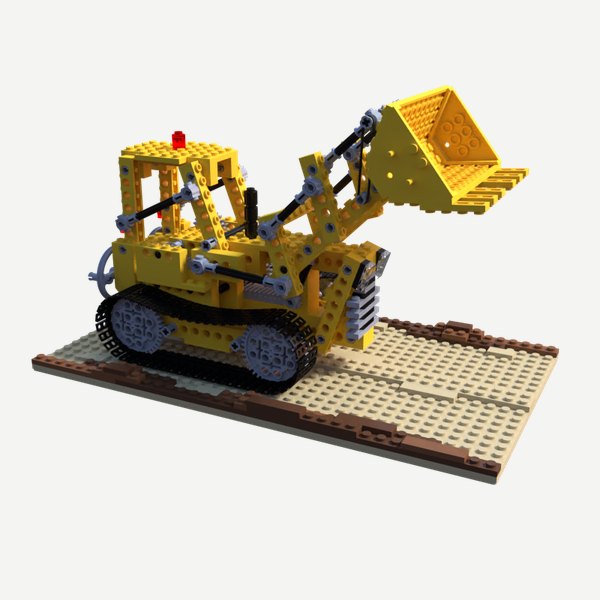
The data. I used NeRF-Synthetic, a public dataset of 8 objects, each photographed from 100 known spots on a dome around it. Those spots are where the drone can fly. It hops between neighbouring spots and only gets a handful of photos.
The agent. I trained a reinforcement learning agent (PPO) to pick each next spot. Training it and rendering 3D scenes takes serious computing power, so I ran the simulations on an NVIDIA GPU server at Seoul National University.
Result. On the lego scene, the agent covered the object faster than a simple "go where you haven't looked" rule for the first several photos, and beat random flights the whole way.